
Implementation and Verification of Satellite IoT Transceiver for Global Service
Vol. 51, No. 4, pp. 834-840, Apr. 2026
 10.7840/kics.2026.51.4.834
PDF Full-Text
Abstract
Statistics
Cumulative Counts from November, 2022
Multiple requests among the same browser session are counted as one view. If you mouse over a chart, the values of data points will be shown.
Multiple requests among the same browser session are counted as one view. If you mouse over a chart, the values of data points will be shown.
|
|
Cite this article
[IEEE Style]
S. Jung, M. Oh, P. Kim, "Implementation and Verification of Satellite IoT Transceiver for Global Service," The Journal of Korean Institute of Communications and Information Sciences, vol. 51, no. 4, pp. 834-840, 2026. DOI: 10.7840/kics.2026.51.4.834.
[ACM Style]
Sooyeob Jung, Mi-Kyung Oh, and Pansoo Kim. 2026. Implementation and Verification of Satellite IoT Transceiver for Global Service. The Journal of Korean Institute of Communications and Information Sciences, 51, 4, (2026), 834-840. DOI: 10.7840/kics.2026.51.4.834.
[KICS Style]
Sooyeob Jung, Mi-Kyung Oh, Pansoo Kim, "Implementation and Verification of Satellite IoT Transceiver for Global Service," The Journal of Korean Institute of Communications and Information Sciences, vol. 51, no. 4, pp. 834-840, 4. 2026. (https://doi.org/10.7840/kics.2026.51.4.834)
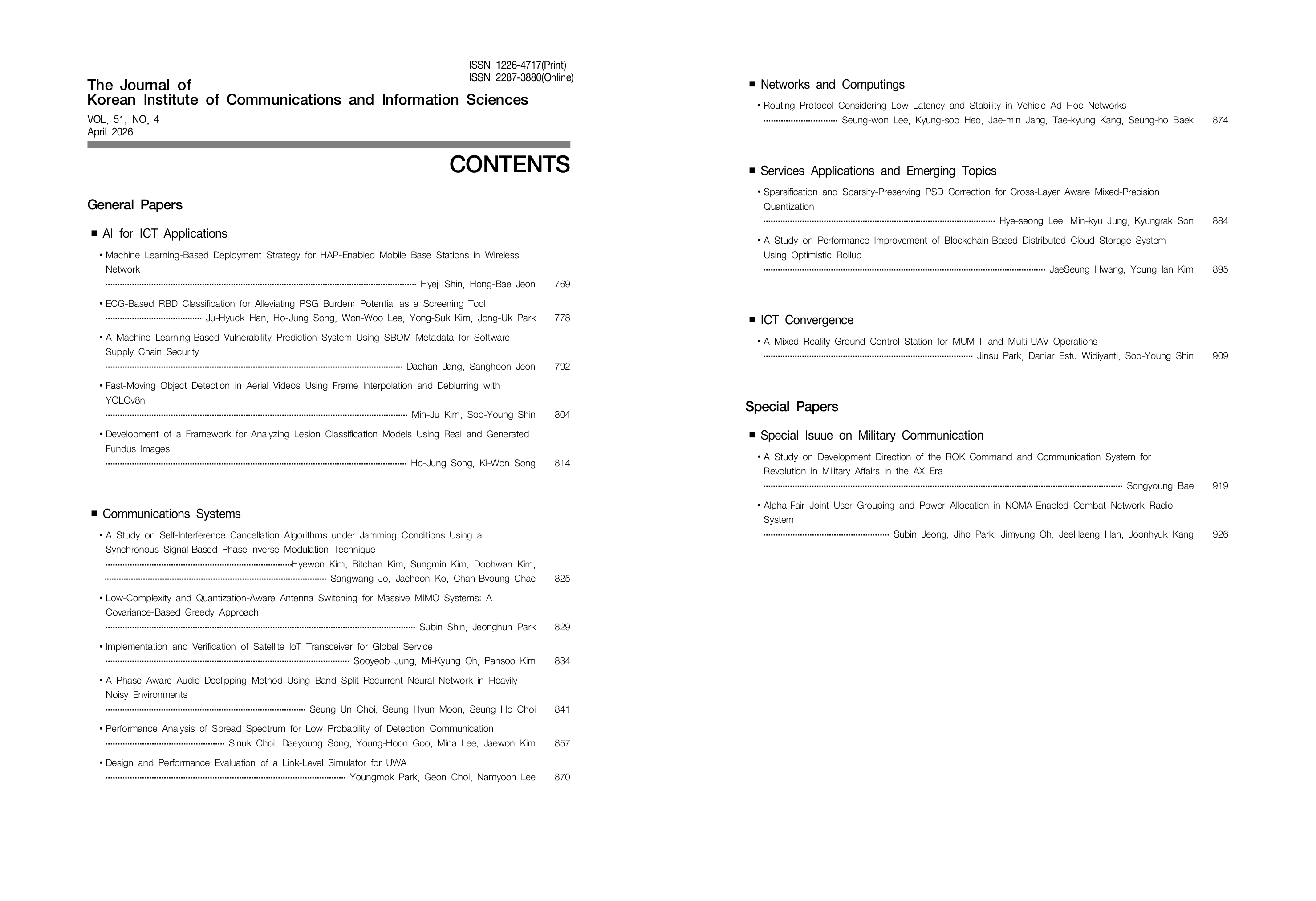
Vol. 51, No. 4 Index


pISSN : 1226 - 4717
eISSN : 2287 - 3880