IndexFiguresTables |
Yejin Lee , Minseok Han and Hosung ParkDesign of Distributed Root Protograph LDPC Codes for Block Fading ChannelsAbstract: In this letter, we propose a distributed root proto- graph (DRP) design for block fading (BF) channels that starts from the conventional RP structure to sup- port a higher code rate of 1/( − 1). Although the proposed codes do not achieve full diversity, they at- tain the maximum diversity for given code rate and show a slope of frame error rate (FER) approaching the channel outage probability. Keywords: Block fading channel , Low-Density Parity-Check code , Rootcheck , Diversity order , Outage probability Ⅰ. IntroductionLow-Density Parity-Check (LDPC)[1] codes are well known for approaching shannon capacity under iterative belief propagation (BP) decoding and performing well on additive white Gaussian noise (AWGN) channels. However, their performance significantly degrades in the block fading (BF)[2] channels where the channel remains constant within each data block. Research on LDPC codes over BF channels[3] includes the following. Root LDPC codes[4] were first introduced to achieve full diversity over BF channels via rootchecks. Root protograph (RP) LDPC codes[5] improved encoding efficiency using protograph structures, and rate-compatible RP (RCRP) codes[6] extended to lower code rates than 1/L through matrix extension. However, these codes have a fixed code rate of 1/L and have only been extended to lower code rates to satisfy the Singleton bound for full diversity. Subsequent works explored high-rate LDPC codes such as generalized RP (GRP)[7] or resolvable block design (RBD)[8]. Thus, we also focus on the code rate and propose an RP-based protograph with a higher rate of 1/(L − 1). It achieves the maximum diversity for the given code rate and outperforms random LDPC codes due to its root-based structure. Finally, Monte Carlo simulations show a slope of frame error rate (FER) approaching the channel outage probability. Ⅱ. PreliminariesIn BF channel with L blocks, a codeword of length N is divided into L equal-length blocks, each of length T = N /L, and each block is affected by an independent fading coefficient. When symbol [TeX:] $$x_j$$ is transmitted, the received symbol [TeX:] $$y_j$$ is given as
where [TeX:] $$l=\lceil j / T\rceil, x_j \in \pm 1$$ is a binary phase shift keying (BPSK) modulated symbol, and [TeX:] $$n_j \sim \mathcal{N}(0,\left.\sigma_n^2\right)$$ is AWGN. The fading coefficient [TeX:] $$\alpha_l$$ follows an i.i.d. Rayleigh distribution with [TeX:] $$\mathbb{E}\left[\alpha_l^2\right]=1 .$$ Since BF channel characteristics vary over time, the theoretical channel capacity is zero. Hence, the outage probability is used as a performance metric, defined as the probability that the instantaneous mutual information (MI) [TeX:] $$I(\bar{\gamma})$$ is less than the data transmission rate R, where [TeX:] $$\bar{\gamma}$$ denotes the signal-to-noise ratio (SNR).
This probability depends on the fading conditions and represents the fundamental limit for the FER of a particular coding scheme. The diversity order refers to the maximum number of failed paths through which information can still be successfully transmitted and corresponds to the slope of the FER curve at high SNR on a log-log scale, where [TeX:] $$P_F$$ is FER.
It is theoretically upper bounded by the Singleton bound.
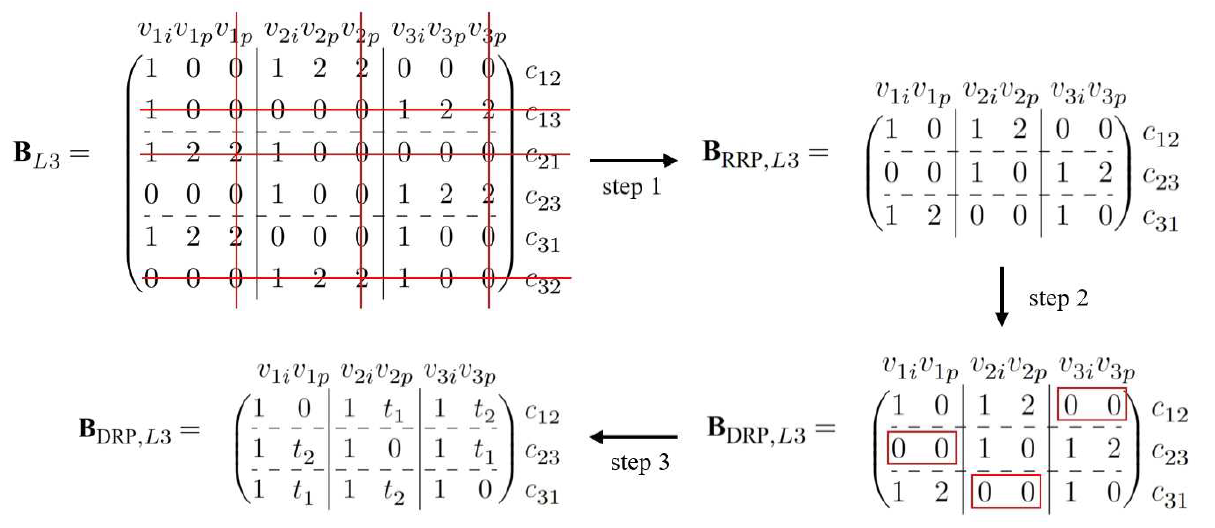
In BF channel with L blocks, a full diversity code has diversity order of L and is achievable only when R ≤ 1/L from (4). If R > 1/L, full diversity cannot be achieved, and the highest possible diversity order at that rate is called the maximum diversity. Ⅲ. Proposed method3.1 RP LDPC codesRP[5] LDPC code is an extension of root protograph with rootchecks, which achieves full diversity over BF channel with L blocks and has a code rate of R = 1/L. A rootcheck is a special check node that connects to exactly one information node in a specific block, while all its remaining edges connect to nodes in another block. The variable node set of RP is defined as [TeX:] $$\mathcal{V}=\mathcal{V}_1 \cup \mathcal{V}_2 \cup \cdots \cup \mathcal{V}_L,$$ where each [TeX:] $$\mathcal{V}_l$$ corresponds to the VN set of l-th block and consists of one information node [TeX:] $$v_{li}$$ and L − 1 parity nodes [TeX:] $$v_{lp}$$, i.e., [TeX:] $$\mathcal{V}_l=\left\{v_{l i}\right\} \cup\left\{v_{l p}^{(s)} \mid s=1, \ldots, L-1\right\} .$$ Similarly, the check node set is defined as [TeX:] $$\mathcal{C}=\mathcal{C}_1 \cup \mathcal{C}_2 \cup \cdots \cup \mathcal{C}_L,$$ where each [TeX:] $$\mathcal{C}_l$$ contains L − 1 rootcheck nodes connected to [TeX:] $$v_{l i},$$ given by [TeX:] $$\mathcal{C}_l=\left\{c_{l s} \mid s=1,2, \ldots, L, s \neq l\right\}.$$ For example, the base matrix of regular RP for L = 3 is shown as (5).
(5)[TeX:] $$\mathbf{B}_{L3}=\begin{array}{c} \begin{array}{ccccccccc} v_{1i} v_{1p} v_{1p} & v_{2i} v_{2p} v_{2p} & v_{3i} v_{3p} v_{3p} \end{array}\\ \left(\begin{array}{ccc|ccc|ccc} 1 & 0 & 0 & 1 & 2 & 2 & 0 & 0 & 0 \\ 1 & 0 & 0 & 0 & 0 & 0 & 1 & 2 & 2 \\ \hdashline 1 & 2 & 2 & 1 & 0 & 0 & 0 & 0 & 0 \\ 0 & 0 & 0 & 1 & 0 & 0 & 1 & 2 & 2 \\ \hdashline 1 & 2 & 2 & 0 & 0 & 0 & 1 & 0 & 0 \\ 0 & 0 & 0 & 1 & 2 & 2 & 1 & 0 & 0 \end{array}\right) \end{array} \begin{gathered}\\ c_{12} \\ c_{13} \\ c_{21} \\ c_{23} \\ c_{31} \\ c_{32} \end{gathered}$$Even if [TeX:] $$\mathcal{v}_1, \mathcal{v}_2$$ all deep fade, the information remains recoverable via the rootchecks in [TeX:] $$\mathcal{C}_3.$$ 3.2 DRP LDPC codesWe propose a design method for distributed RP (DRP) structures with a higher code rate of R=1/(L-1), starting from the regular RP structure with a code rate of R=1/L. This method is illustrated using the example of [TeX:] $$\mathbf{B}_{L 3},$$ but it can also be applied to other regular RP such as [TeX:] $$\mathbf{B}_{L 4}.$$ Also we begin with the regular RP for simplicity, the same approach can be extended to irregular RPs that include rootchecks. RCRP[6] structure was designed with a lower code rate than 1/L by expanding the regular RP through the addition of L variable nodes (columns) and L check nodes (rows). Inspired by this approach, we propose an inverse method to construct RPs with higher code rates than 1/L: 1. Remove L columns and L rows from the regular RP structure. 2. Add a new distributed rootcheck connection. 3. Treat the parity nodes as free variables and search by modified PEXIT. Specifically, for each [TeX:] $$l=1, \ldots, L,$$ one parity node [TeX:] $$v_{l p}$$ is removed from [TeX:] $$\mathcal{V}_l$$, and one rootcheck node [TeX:] $$c_{l s}$$ is removed from [TeX:] $$\mathcal{C}_l,$$ where [TeX:] $$s=((l-2+L) \bmod L)+1.$$ With this construction, the information nodes [TeX:] $$v_{l i}$$ keep unchanged, and the associated rootcheck nodes are uniformly removed, preserving the structural regularity of the graph. Because the rootchecks connected to [TeX:] $$v_{l i}$$ and [TeX:] $$\mathcal{V}_{((l-2+L) \bmod L)+1}$$ are removed - that is, the rootchecks such as [TeX:] $$c_{l s} \text { where } s=((l-2+L) \bmod L)+1$$ - the removed RP (RRP) structure in Fig. 1 allows recovery only when no more than L − 2 blocks undergo deep fading. Thus, the RRP can achieve maximum diversity of L − 1, which is consistent with the Singleton bound. Although the RRP still achieves the maximum diversity of L − 1 for that given code rate, we further introduce a new distributed rootcheck connection to enhance the coding gain. For each l = 1, … , L, the distributed rootcheck refers to the additional connection of variable nodes in [TeX:] $$\mathcal{V}_{((l-2+L) \bmod L)+1}$$ to the existing rootcheck node [TeX:] $$c_{l s},$$ where [TeX:] $$s=(l+1) \bmod L .$$ This compensates for the removed rootcheck [TeX:] $$c_{l s}$$ where [TeX:] $$s={((l-2+L) \bmod L)+1}$$, while preserving the maximum diversity. The specific connections of DRP are determined by treating the parity nodes, excluding the information nodes, as free variables [TeX:] $$t_{i j}$$ and applying the modified PEXIT[5] method to search for an optimized protograph structure. Although all combinations of the free variables [TeX:] $$t_{i j}$$ can be searched, it is computationally intensive. To simplify the process, we define the [TeX:] $$t_{i j}$$ values in each [TeX:] $$\mathcal{C}_l$$ by cyclically shifting those in [TeX:] $$\mathcal{C}_1.$$ Using a restricted range [TeX:] $$t_{i j} \in\{0,1,2\},$$ the proposed DRP structures [TeX:] $$\mathbf{B}_{\mathrm{DRP}, L 3} \text { and } \mathbf{B}_{\mathrm{DRP}, L 4}$$ are constructed as follows.
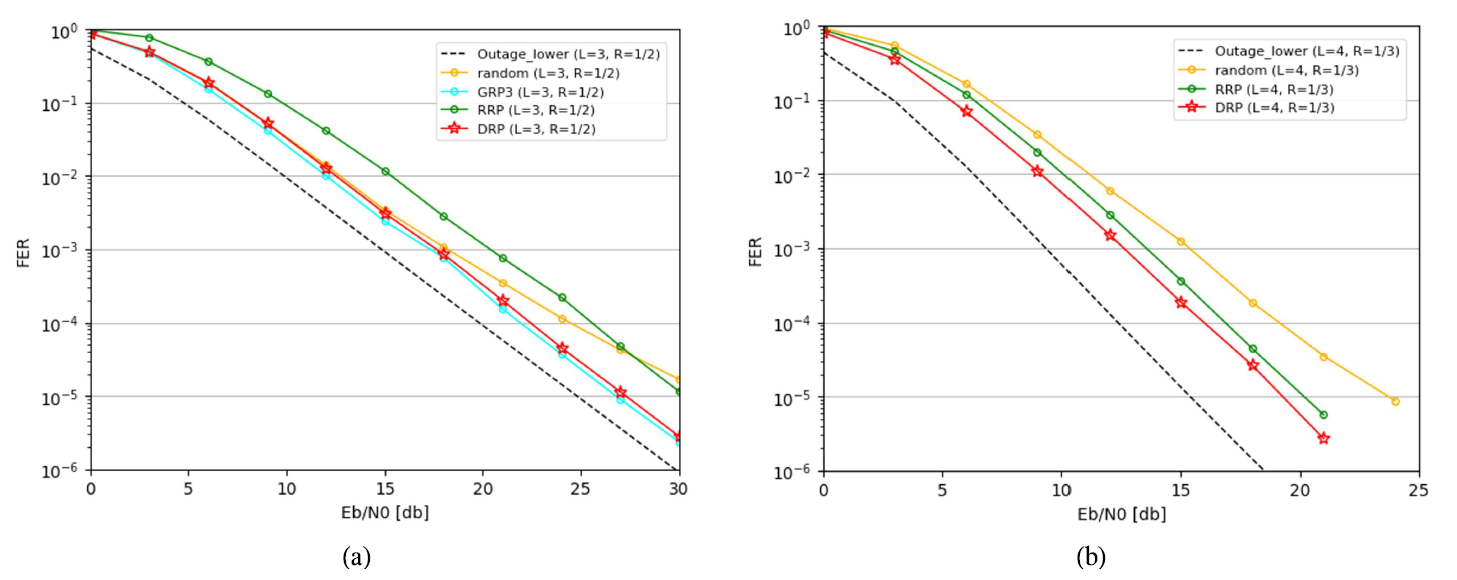
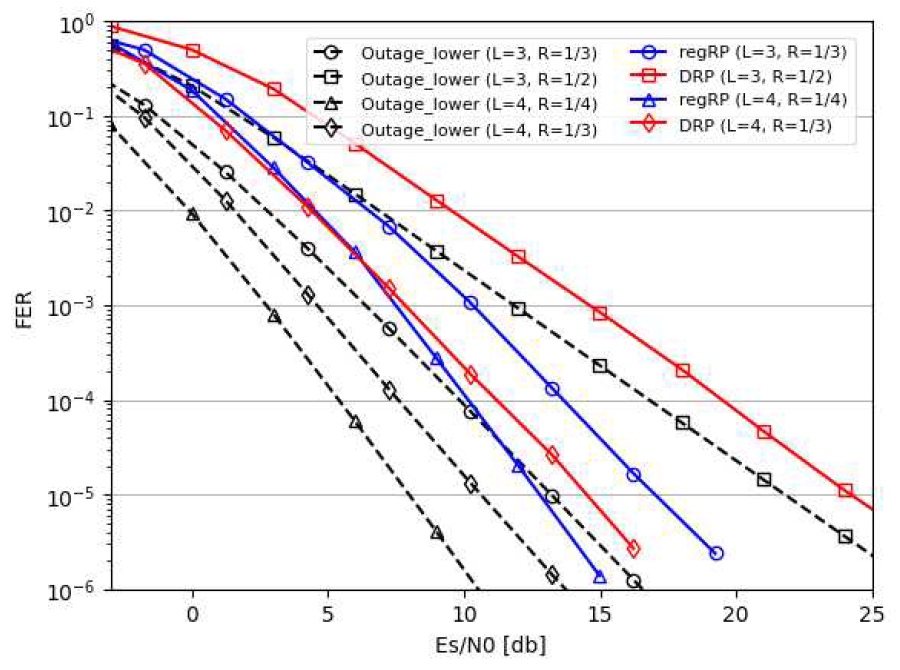
[TeX:] $$\begin{aligned} & \mathbf{B}_{\text {DRP }, L 3}=\left(\begin{array}{cc|cc|cc} 1 & 0 & 1 & 2 & 1 & 1 \\ 1 & 1 & 1 & 0 & 1 & 2 \\ 1 & 2 & 1 & 1 & 1 & 0 \end{array}\right) \\ & \mathbf{B}_{\text {DRP }, L 4}=\left(\begin{array}{lll|lll|lll|lll} 1 & 0 & 0 & 1 & 1 & 1 & 0 & 0 & 0 & 1 & 0 & 0 \\ 1 & 0 & 0 & 0 & 0 & 0 & 1 & 2 & 1 & 0 & 0 & 0 \\ 1 & 0 & 0 & 1 & 0 & 0 & 1 & 1 & 1 & 0 & 0 & 0 \\ 0 & 0 & 0 & 1 & 0 & 0 & 0 & 0 & 0 & 1 & 2 & 1 \\ 1 & 2 & 1 & 0 & 0 & 0 & 1 & 0 & 0 & 0 & 0 & 0 \\ 0 & 0 & 0 & 1 & 0 & 0 & 1 & 0 & 0 & 1 & 1 & 1 \\ 1 & 1 & 1 & 0 & 0 & 0 & 1 & 0 & 0 & 1 & 0 & 0 \\ 0 & 0 & 0 & 1 & 2 & 1 & 0 & 0 & 0 & 1 & 0 & 0 \end{array}\right) \end{aligned}$$ Ⅳ. Simulation ResultsThe decoding performance is evaluated in terms of frame error rate (FER), which is defined as the probability that a transmitted codeword is decoded incorrectly. This section compares the FER performance of the proposed DRP LDPC codes over BF channels with L = 3, 4 against random and RRP LDPC codes. Random LDPC codes use all-one base matrices of size 3 × 6, 4 × 6. RRP codes are obtained by removing L rows and columns from the regular RP structure. For L = 3, GRP3[7] with R = 1/2 is also compared. Fig. 2 demonstrates that the proposed DRP LDPC codes outperform random LDPC codes in both coding gain and diversity. While GRP code performs best for L = 3, it is limited to rates that achieve only diversity order 2. The DRP, with distributed rootcheck connections, achieves better coding gain than the RRP at the same rate and reaches the maximum diversity of L − 1. Furthermore, Fig. 3 shows that the proposed DRP exhibits a smaller gap to the outage probability compared to the regular RP. This is attributed to the increased design flexibility achieved by allowing degree irregularity, which leads to improved coding gain. As illustrated in the graph, the DRP demonstrates a smaller gap not only compared to the regRP with the same number of blocks but also to the regRP with the same code rate. Ⅴ. ConclusionWe proposed a DRP LDPC code that improves error performance over BF channels by starting from RP structures. The design achieves near-outage-limit FER while maintaining maximum diversity for its rate through distributed rootcheck connections. Simulation results show its advantage over existing protograph ldpc codes in both coding gain and diversity order. References
|
StatisticsCite this articleIEEE StyleY. Lee, M. Han, H. Park, "Design of Distributed Root Protograph LDPC Codes for Block Fading Channels," The Journal of Korean Institute of Communications and Information Sciences, vol. 50, no. 11, pp. 1735-1738, 2025. DOI: 10.7840/kics.2025.50.11.1735.
ACM Style Yejin Lee, Minseok Han, and Hosung Park. 2025. Design of Distributed Root Protograph LDPC Codes for Block Fading Channels. The Journal of Korean Institute of Communications and Information Sciences, 50, 11, (2025), 1735-1738. DOI: 10.7840/kics.2025.50.11.1735.
KICS Style Yejin Lee, Minseok Han, Hosung Park, "Design of Distributed Root Protograph LDPC Codes for Block Fading Channels," The Journal of Korean Institute of Communications and Information Sciences, vol. 50, no. 11, pp. 1735-1738, 11. 2025. (https://doi.org/10.7840/kics.2025.50.11.1735)
|